
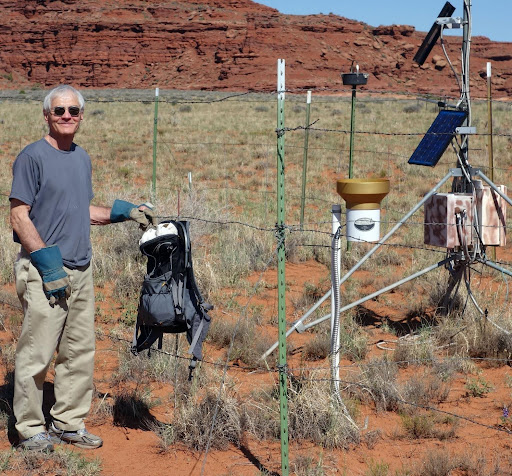
A Biographical Sketch by Giles Wiggs
Dr Richard Reynolds gained his undergraduate degree in Geological Sciences (Cum Laude) at Princeton University in 1968, followed by a Masters degree (1970) and PhD (1975) at the University of Colorado. His PhD focused on mapping and interpreting the geology of the Yellowstone region and his work significantly contributed to the understanding of the role of calderas to Yellowstone’s origins. Dr Reynolds early work, which has continued throughout his research career, focussed on the technical development and application of methods of determining rock and mineral geomagnetics in order to interpret and understand environmental change. His career has been deeply founded in the United States Geological Survey (USGS) where he started work as a Geologist in 1968, becoming a Senior Research Geologist in 1975, Program Manager in 2002, Chief Scientist in 2009, and Senior Scientist in 2012. On retirement Dr Reynolds was awarded the title of Scientist Emeritus by the USGS. He is an Adjunct Research Professor at the University of Minnesota and has had significant academic and administrative responsibilities at the University of Colorado and the National Science Foundation.
Dr Reynolds’ lifelong interest in desert landscapes and processes began with the first of his two postings to the Antarctic in 1970 where he was part of a team undertaking some of the first mapping of the geology and geomorphology of the Lassiter Coast region. “Reynolds Bench” is a feature on the north side of the Kelley Massif named after him. Further field projects undertaken with the USGS to Egypt and Saudi Arabia cemented his interest and in 1997/8 he began leading the large USGS programme focused on geomorphology and surface processes in the deserts of the SW USA, and especially the Colorado Plateau. Whilst his position leading this programme included managing projects on various geomorphological, hydrological, and biological systems in the region, it was aeolian dust which piqued Dr Reynolds’ interest. He co-ordinated some of the most intensive and successful research into the emission, transport, and deposition of aeolian dust in the SW USA, laying the groundwork for many of the research leaders in the field of dust dynamics today, and leaving a lasting legacy of research excellence and knowledge of aeolian processes and impacts.
Dr Reynolds’ leadership of this USGS programme continued until his retirement in 2013. Within this time, he led research teams and guided research projects to produce some of the most significant papers in the discipline, applying his knowledge of geochemistry to unravel the geologic, biologic, and human controls on dust generation, as well as the mineralogic and geochemical properties of dust that affect climate, ecosystems, water resources (through the effects of dust on the melting of snow and ice), ocean fertility, and human health. He has led and contributed to very highly-cited research (with over 8700 citations, Google Scholar) across an enormous breadth of critical research on aeolian dust. This includes groundbreaking work on the geochemical controls on dust emission from playa lakes (Reynolds et al., 2007); the role of human activity in regional scale dust generation (Reynolds et al., 2010; Neff et al., 2008; Belnap et al., 2009); the ecology of dust (Reynolds et al., 2006; Field et al, 2010); aeolian sand transport pathways (Muhs et al., 2003); dust geochemistry and nutrient distribution (Reynolds et al, 2001; Reheis et al., 2009; Neff et al., 2005); wind erosion and fire (Miller et al., 2012); and the impact of dust on snow melting (Skiles et al., 2015).
He has won a suite of awards and fellowships for his research in both geology and geomorphology, including the award for the Best Paper in Geophysics (1992), the Meritorious Service Award from the US Department of the Interior (1995), the award for Best Paper in the Journal of Great Lakes Research (1995), and the Kirk Bryan Award for best publication in the field of Quaternary Geology and Geomorphology from the Geological Society of America (2007). Dr Reynolds was both an Astor Visiting Fellow (2011) and a Distinguished Visiting Scholar (2012-2014) at the University of Oxford.
Perhaps Dr Reynold’s most significant contribution to the aeolian community is his kindness, patience, and gentle mentorship that he offers to all, from early career academics to senior professors. To this day he continues to offer mentorship and guidance through a number of scientific programmes. His work has been forged through his tremendous gift in bringing together inter-disciplinary teams to work towards a common goal, making a true success of teamwork and collaboration. He has been a huge supporter of the aeolian research community and a tremendous ambassador for aeolian and environmental research, including at high political level in his time as a USGS programme manager. He has consistently contributed to and supported many ICAR meetings.
Dr Reynolds is the epitome of collaborative aeolian science. He is an eminent research scientist and his career has been prestigious in every way. It is fitting that Dr Reynolds career is celebrated by the award of the ISAR Distinguished Career Award