
A Biographical Sketch By Jeffrey A. Lee
Junran “Jimmy” Li grew up in Hubei, the “Province of a Thousand Lakes,” in southern China. He developed a deep love for nature from an early age. While many other children were busy studying math and English, he spent much of his free time outside school watching birds and insects, catching fish, and exploring rivers and lakes.
In 1994, his passion for nature led him to study geology at Jilin University, a highly selective institution in northeastern China. In 1998, Junran was among the few in his cohort admitted for a master’s program at the prestigious Chinese Academy of Sciences in Beijing, where he studied ecosystem ecology. He was first introduced to aeolian research in 2003, when he began his PhD studies at the University of Virginia under the supervision of Professor Gregory Okin. After completing his dissertation in 2008, he conducted postdoctoral research at Cornell University and then in the Department of Geography at UCLA. In 2013, he joined the University of Tulsa in Oklahoma as an assistant professor. He earned tenure and was promoted to associate professor in 2019. In 2022, he decided to return to Asia and joined the Department of Geography at the University of Hong Kong as an associate professor.
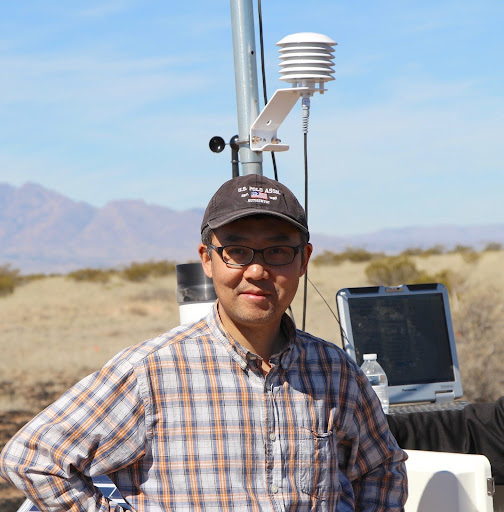
Junran worked on a wildfire and aeolian activities project in Sevilleta, New Mexico, USA
Since his introduction to the aeolian community in 2006, Junran has become an active and engaged member since his first ICAR in Guelph (2006). From 2013 to 2023, he served as Associate Editor for Aeolian Research, during which he received the Excellent Associate Editor Award in 2014. Currently, he continues his service to the aeolian community as Associate Editor for Journal of Geophysical Research-Earth Surface and Earth’s Future.
Junran’s research has consistently centered on the role of aeolian processes in shaping ecosystem dynamics in arid and semiarid environments, as well as the impacts of dust on human well-being. He has published more than 100 articles in leading international journals, which have garnered 4,218 citations and an H-index of 34. He has taught a range of courses including Geomorphology, Global Landforms, Energy, Environment & Climate, Nature Conservation for Sustainable Societies, Introduction to GIS, Hydrogeology, and Environmental Geochemistry. Throughout his career, Junran has supervised 14 Master and PhD students, 3 postdoctoral scholars, and numerous undergraduate researchers in his lab. His mentees included first-generation college students, veterans, women from underrepresented groups, and students with disabilities.
Using the Jornada Experimental Range in southern New Mexico as a natural laboratory, Junran pioneered investigations into the role of aeolian processes in driving rapid ecosystem changes. His research was the first to demonstrate that aeolian transport, in addition to hydrological processes, plays a critical role in the formation and evolution of “islands of fertility.”
Dr Li will provide a virtuaeolian seminar about his work on 13 May entitled: “Dust activities in East Asia in the 21st century: Beyond declining?”