
Date and Time: April 13th, 2026 at 17:00 Amsterdam time/23:00 Beijing time.
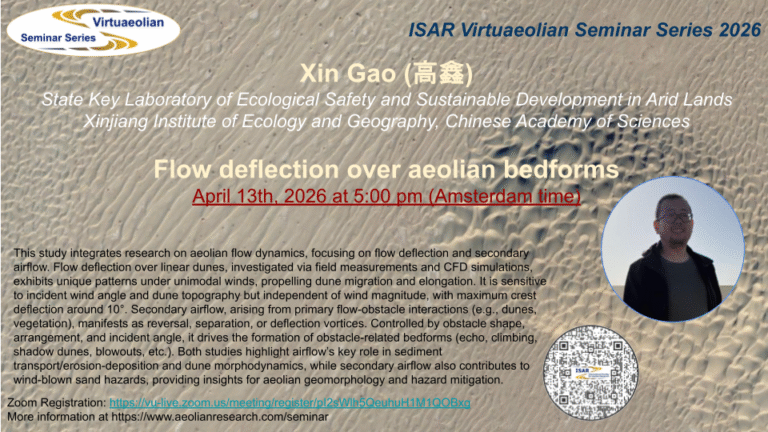
This study integrates research on aeolian flow dynamics, focusing on flow deflection and secondary airflow. Flow deflection over linear dunes, investigated via field measurements and CFD simulations, exhibits unique patterns under unimodal winds, propelling dune migration and elongation. It is sensitive to incident wind angle and dune topography but independent of wind magnitude, with maximum crest deflection around 10°. Secondary airflow, arising from primary flow-obstacle interactions (e.g., dunes, vegetation), manifests as reversal, separation, or deflection vortices. Controlled by obstacle shape, arrangement, and incident angle, it drives the formation of obstacle-related bedforms (echo, climbing, shadow dunes, blowouts, etc.). Both studies highlight airflow’s key role in sediment transport/erosion-deposition and dune morphodynamics, while secondary airflow also contributes to wind-blown sand hazards, providing insights for aeolian geomorphology and hazard mitigation.